







Executive Summary -
Highlights of Cyber Threat Intelligence Digest
Vulnerabilities
Notepad++ Patches Three Vulnerabilities CVE-2026-48770, CVE-2026-48778, CVE-2026-48800 - On 26 May 2026, Notepad++ released version 8.9.6.1 to patch three vulnerabilities affecting the Windows editor in versions up to and including 8.9.6, with no reports of exploitation in the wild at the time of writing. CVE-2026-48770 is a moderate-severity denial-of-service flaw where a malformed inter-process communication message can crash the application within the same Windows session.
The remaining two are high-severity arbitrary code execution vulnerabilities. CVE-2026-48778 targets the configured command-line interpreter, allowing code execution when a user opens a containing folder in Command Prompt if the configuration has been tampered with. CVE-2026-48800 similarly exploits user-defined commands in shortcuts.xml, enabling code execution when a malicious Run menu entry is selected.
CERT/CC Discloses CVE-2026-10621 and CVE-2026-10622 in Collibra Platform - On 2 June 2026, CERT/CC disclosed two vulnerabilities affecting the Collibra Agent component of the Collibra Platform, used in both SaaS and self-hosted deployments. Collibra had already released patches on 31 May 2026, and there are no reports of active exploitation at the time of writing.
CVE-2026-10621 is a path traversal vulnerability in the agent's restore functionality, where improper validation of file paths during ZIP extraction could allow an attacker to write arbitrary files outside the intended directory, potentially leading to remote code execution. CVE-2026-10622 is an improper authentication vulnerability caused by inadequate access controls on privileged REST API endpoints, allowing a threat actor to access privileged functionality without any authentication. Affected users should apply the available patches promptly.
IBM Patches Critical WebSphere Application Server Vulnerabilities CVE-2026-8644, CVE-2026-9319, CVE-2026-9311 and CVE-2026-9330 - On 1 June 2026, IBM disclosed and released interim fixes for four vulnerabilities affecting IBM WebSphere Application Server traditional versions 8.5 and 9.0, with no evidence of active exploitation at the time of writing. The two most critical are CVE-2026-8644 (severity 9.1), an identity spoofing vulnerability caused by authentication bypass, and CVE-2026-9319 (severity 9.0), a remote code execution flaw affecting deployments using JAX-WS endpoints with WS-Security, exploitable by unauthenticated attackers via deserialization of untrusted data.
The remaining two are also rated high severity. CVE-2026-9311 (severity 9.0) enables remote code execution through a bypass of security controls, whilst CVE-2026-9330 (severity 8.5) affects the SAML Web Single Sign-On component, where improper validation of user-supplied data during deserialization can be exploited via a crafted HTTP request combined with a suitable gadget chain. IBM recommends applying the available interim fixes for the associated APARs or upgrading to fixed WebSphere Application Server fix packs when available.
Potential Threats
Threat Actors Impersonate Anthropic Claude Code Installation Process to Deploy Reflective .NET Infostealer and Steal Browser Credentials - On 28 May 2026, Cyderes reported a campaign in which threat actors used SEO poisoning to impersonate Anthropic's Claude Code installation process, targeting non-technical users such as small business owners and teachers seeking installation guidance. The campaign abused Anthropic's branding without compromising Anthropic itself, delivering a .NET infostealer designed to access browser-stored credentials and exfiltrate sensitive data.
The attack began with a ClickFix lure instructing victims to run a command via the Windows Run dialog, which retrieved a polyglot payload containing legitimate audio content alongside an embedded HTA script. The HTA created a scheduled task launching a 32-bit PowerShell instance, which bypassed AMSI, generated a victim-specific URL using an MD5 hash of the machine and username, and fetched a second-stage obfuscated PowerShell script executed entirely in memory. This script used Assembly.Load to reflectively load the .NET infostealer into the existing PowerShell process, exfiltrating browser credentials without ever writing the payload to disk.
DriveSurge Uses ClickFix and Fake Update Lures Across Compromised Websites - On 30 May 2026, Silent Push reported on a threat actor tracked as DriverSurge, which operates a large-scale malware distribution campaign across thousands of compromised websites. Silent Push assesses that DriverSurge likely functions as an Initial Access Broker operating on a Pay-Per-Install model, delivering malware and selling victim access to downstream threat actors, with eight distinct infrastructure fingerprints identified to track its operations.
The infection chain begins with malicious JavaScript injected into compromised sites, redirecting visitors through a traffic distribution system that profiles victims and determines the appropriate next-stage payload. Depending on the victim profile, DriverSurge serves either FakeUpdates pages impersonating popular browsers - including Chrome, Firefox, Edge, and others - distributing malware disguised as software updates, or ClickFix lures that instruct users to execute malicious PowerShell or terminal commands directly on their machines.
Threat Actors Distribute Fileless PureLogs Information Stealer in Phishing Campaign Targeting Windows Users - On 26 May 2026, Fortinet reported a phishing campaign distributing a fileless variant of the PureLogs information stealer targeting Windows users. Delivered via purchase-order-themed emails containing a RAR archive with an obfuscated JavaScript file, the malware is capable of harvesting a broad range of sensitive data including browser credentials, cookies, session tokens, screenshots, clipboard contents, cryptocurrency wallet data, Discord tokens, and credentials from applications such as Outlook, Thunderbird, FileZilla, and various VPN clients, before compressing, encrypting, and transmitting the collected data to command-and-control infrastructure.
The execution chain begins when the JavaScript decrypts and launches a hidden PowerShell script, which decodes and runs an in-memory payload. This payload performs process hollowing against a legitimate MsBuild.exe instance - creating a suspended process, replacing its memory with a malicious .NET module, and resuming execution. The injected module then runs a downloader within the hollowed process, which retrieves an encrypted plugin from the C2 server, decrypts and decompresses it entirely in memory, and executes the final fileless PureLogs payload without ever writing it to disk.
General News
White House unveils pared-back AI executive order - The White House released a revised AI executive order after an initial version was scrapped last month following internal dissent, most notably from former AI and crypto czar David Sacks, who raised concerns about harm to innovation and competitiveness with China. The key change is a reduction in the voluntary government review period for AI models from 90 days to 30 days post-release, a compromise after industry had pushed for just 14 days. The order was signed behind closed doors and explicitly states the voluntary framework should not be interpreted as authorising any mandatory licensing or permitting requirements for AI development.
On cybersecurity, the order directs industry and government to collaborate on designating "covered frontier" models accessible to trusted partners for critical infrastructure protection and classified cyber threat tracking, alongside the creation of a Treasury-led AI cybersecurity clearinghouse. It also tasks CISA, the Office of the National Cyber Director, and the Office of Management and Budget with identifying federal grant funding for AI vulnerability detection. Senate Intelligence Committee Chairman Mark Warner broadly endorsed the measures, whilst noting that several provisions echoed those in the Biden-era AI executive order that was rescinded on the first day of the current administration.
Microsoft says it will not pursue security researchers after zero-day backlash - Microsoft clarified it has "no intention to pursue action" against security researchers who publish vulnerability findings, days after an official blog post sparked significant backlash. The original post had condemned a series of uncoordinated Windows zero-day releases by pseudonymous researcher Nightmare Eclipse as "never justifiable," with language widely perceived as threatening. The security community rallied around the researcher, who alleged Microsoft had deleted their MSRC account, withheld bounty payments, and removed their attribution from at least one advisory - allegations Microsoft did not directly address in its follow-up statement.
The new statement, shared via social media rather than Microsoft's official blog, acknowledged that "some interactions have fallen short" and notably dropped the phrase "responsible disclosure" in favour of "Coordinated Vulnerability Disclosure," a term Microsoft itself adopted in 2010 to avoid implying that non-compliant researchers are behaving irresponsibly. Security professional Katie Moussouris, who helped retire the earlier term whilst at Microsoft, had flagged its reappearance as deliberately loaded. Meanwhile, Nightmare Eclipse announced that following recent events other researchers had begun sharing vulnerabilities with them directly, and that a new Secure Boot vulnerability - reportedly capable of fully bypassing BitLocker and potentially compromising confidential virtual machines - would be released sometime in June.
Russia conducting daily attacks on UK 'from seabed to cyberspace,' spy chief warns -The head of GCHQ, Anne Keast-Butler, used a speech at Bletchley Park to deliver a stark warning that Russia is conducting daily hybrid attacks against the UK and Europe, targeting critical infrastructure, democratic processes, supply chains and public trust across everything from undersea cables to corporate networks. She called on businesses and government to treat cybersecurity with ten times greater urgency, noting that the risk of miscalculation is "as high as I have ever seen it." Countermeasures already underway include defending subsea cables, disrupting Russian sanctions-busting networks, and - disclosed last month - tracking and forcing the retreat of a Russian submarine operation near critical seabed infrastructure.
Keast-Butler also highlighted the growing threat posed by China, which she described as a science and technology superpower with sophisticated cyber and military capabilities, echoing recent Dutch military intelligence assessments. On AI, she announced plans for a new national cyber defence capability embedding agentic AI into systems able to detect and respond to attacks faster than human operators, to be delivered by the National Cyber Security Centre. She further warned that quantum computing will eventually break traditional encryption protecting government, financial, and military systems - including those relating to Britain's nuclear deterrent - and urged businesses to begin transitioning to quantum-resistant systems now.
Threat Actor Weekly Graph
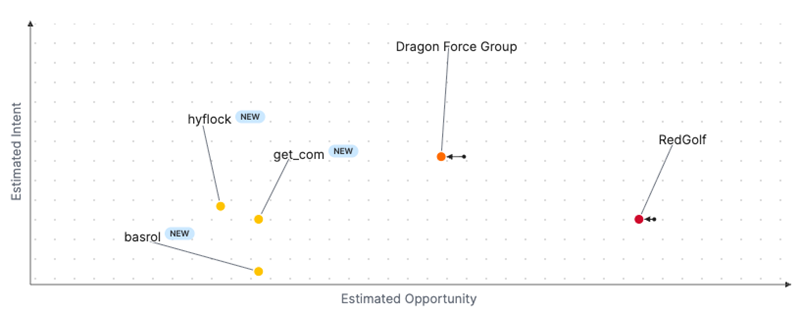
Over the past 7 days, we have been tracking the following intent and opportunity changes within our Threat Actor Landscape.
Intent represents the potential targets of a group. When a group is observed attacking a different organisation or entity, their intent will increase.
Opportunity represents the various methods and technologies these groups may use. For example, if a group started using a new attack vector, such as a new kind of ransomware, their opportunity would increase.
Both intent and opportunity are scored out of 100 and are responsible for scoring the group's severity. These updates can be seen below.
| ● Limited Severity | ● Basic Severity | ● Moderate Severity | ● High Severity |
| Threat Actor | Severity Increase | Opportunity | Intent | ||||||
|---|---|---|---|---|---|---|---|---|---|
| RedGolf | ● High | → | ● High | ● 82 | → | ● 80 | ● 25 | → | ● 25 |
| Dragon Force Group | ● Moderate | → | ● Moderate | ● 57 | → | ● 54 | ● 49 | → | ● 49 |
| get_com | NEW | → | ● Basic | NEW | → | ● 30 | NEW | → | ● 25 |
| hyflock | NEW | → | ● Basic | NEW | → | ● 25 | NEW | → | ● 30 |
| basrol | NEW | → | ● Basic | NEW | → | ● 30 | NEW | → | ● 5 |
Global Trends Powered by Recorded Future
Within each category, we have provided the current top five globally trending items. Each item is linked to how actively trending it is and is marked with a small symbol.
The spikes in references are calculated over 60 days and are normalised to ensure they aren't disproportionate when compared to bigger entities that will naturally have more baseline mentions.
▲- Spike – This indicates a large increase in reporting volume and a high diversity in the event descriptions.
▲- Rise – This indicates a small increase in reporting volume with little diversity in the descriptions.
| Attackers | Methods | Vulnerabilities | Targets | |||||
|---|---|---|---|---|---|---|---|---|
| SideCopy | ▲ | Xeno RAT | ▲ | CVE-2025-48595 | ▲ | Meta | ▲ | |
| KillSecurity Ransomware Group | ▲ | Anubis Ransomware | ▲ | CVE-2026-41091 | ▲ | Central Board of Secondary Education | ▲ | |
| DimasHxR | ▲ | LockBit Ransomware | ▲ | CVE-2024-21182 | ▲ | CJ Group | ▲ | |
| GREYVIBE | ▲ |
3AM Ransomware |
▲ | CVE-2026-41089 | ▲ | TVing | ▲ | |
| Lapsus$ Group | ▲ | Adware | ▲ | CVE-2026-8206 | ▲ | Dashlane | ▲ | |
Prominent Information Security Events
Threat Actors Impersonate Anthropic Claude Code Installation Process to Deploy Reflective .NET Infostealer and Steal Browser Credentials
Source: Insikt Group | Validated Intelligence Event
IOC: Domain - oakenfjrod[.]ru
IOC: IP - 185[.]177[.]239[.]255
On 28 May 2026, Cyderes reported a campaign in which threat actors used SEO poisoning to impersonate Anthropic's Claude Code installation process, deliberately targeting non-technical users such as small business owners, entrepreneurs, and teachers who were searching for installation guidance. By manipulating search engine results to surface malicious pages mimicking legitimate Anthropic content, the attackers were able to reach victims at the precise moment they were most likely to follow installation instructions without scrutiny. Cyderes confirmed that Anthropic itself was not compromised - the campaign was an abuse of Anthropic's branding and installation workflow rather than a breach of its systems.
The attack was initiated via a ClickFix lure, which instructed victims to execute a command through the Windows Run dialog. That command retrieved a polyglot payload cleverly disguised by bundling legitimate audio content alongside an embedded HTA script, helping it evade casual inspection. The HTA then created a scheduled task on the victim's machine, which launched a 32-bit PowerShell instance configured to operate silently in the background.
From there, PowerShell bypassed the Antimalware Scan Interface (AMSI) and generated a victim-specific URL derived from an MD5 hash of the computer and username, adding a degree of targeting and obfuscation to the infrastructure. A second-stage obfuscated PowerShell script was retrieved and executed entirely in memory, using Assembly.Load to reflectively load a .NET infostealer into the existing PowerShell process. The final payload harvested browser-stored credentials and other sensitive data before exfiltrating it - all without ever writing the malicious payload to disk, making detection and forensic recovery significantly more difficult.
DriveSurge Uses ClickFix and Fake Update Lures Across Compromised Websites
Source: Insikt Group | Validated Intelligence Event
IOC: Domain: captioto[.]com
IOC: Hash: 90aecb370dfb1a99a1f7de0a9c6842ab1b664521fddea16b0ec9a91f322646fc
On 30 May 2026, Silent Push reported on a threat actor it tracks as DriverSurge, which operates a large-scale malware distribution campaign across thousands of compromised websites. Silent Push assesses that DriverSurge likely functions as an Initial Access Broker operating on a Pay-Per-Install model, meaning it earns revenue by delivering malware payloads and selling access to compromised victim machines to downstream threat actors. Eight distinct infrastructure fingerprints have been identified to assist in tracking the group's operations, underlining the scale and consistency of its infrastructure.
The infection chain begins when DriverSurge injects malicious JavaScript into compromised websites, silently redirecting visitors through a traffic distribution system known as zTDS. This system profiles each visitor - likely assessing factors such as browser type, location, and device - before determining which next-stage payload to serve, allowing the campaign to tailor its approach to maximise the likelihood of successful infection.
Depending on the victim profile, DriverSurge then presents one of two social engineering techniques. The first is FakeUpdates pages that convincingly impersonate update prompts for a wide range of popular browsers including Chrome, Firefox, Edge, Safari, Opera, Brave, and others, tricking users into downloading malware disguised as a legitimate software update. The second is ClickFix lures, which present fake verification or error messages instructing the victim to paste a malicious command directly into PowerShell or Terminal. Both methods rely on deceiving users into taking an action that initiates the infection themselves, reducing the need for the attacker to exploit any technical vulnerability.
Remediation Actions
Following the information provided above, we recommend that the technologies mentioned be fully patched and updated. We also want to highlight and recommend applying the following patches where applicable:
-
CVE-2026-48770, CVE-2026-48778, CVE-2026-48800 (Notepad++) – These vulnerabilities can be remediated by updating to version 8.9.6.1.
-
CVE-2026-10621, CVE-2026-10622 (Collibra) – Collibra has released 2 patches on 31st May 2026 to fix these vulnerabilities.
-
CVE-2026-8644, CVE-2026-9319, CVE-2026-9311, CVE-2026-9330 (IBM WebSphere) – IBM has released interim fixes for each of these vulnerabilities, and recommend applying them as soon as possible.
If you are currently an Acumen Cyber Vulnerability Management customer, we will be proactively performing related searching and hunting activities within your environment.