







Executive Summary -
Highlights of Cyber Threat Intelligence Digest
Vulnerabilities
Anthropic Discloses CVE-2026-41686 Affecting Claude SDK for TypeScript - On 29th April 2026, Anthropic disclosed CVE-2026-41686, a medium-severity vulnerability (CVSS 4.8) affecting the Claude SDK for TypeScript package @anthropic-ai/sdk, specifically versions 0.79.0 up to but not including 0.91.1, in which the patch was introduced. The flaw stems from the BetaLocalFilesystemMemoryTool creating memory files and directories using Node.js default permissions of 0o666 for files and 0o777 for directories, constituting an insecure default file permissions vulnerability. At the time of writing, no active exploitation has been reported in the wild.
The vulnerability permits local threat actors to read persisted agent state and, in certain environments, modify memory files outright. Successful exploitation could result in the disclosure of sensitive agent state on shared hosts, or the manipulation of subsequent model behaviour in containerised deployments operating with permissive umask configurations. Organisations utilising the affected SDK versions are advised to upgrade to version 0.91.1 or later to remediate the risk.
Apache Patches CVE-2026-23918 HTTP/2 Double-Free Vulnerability in Apache HTTP Server - On 4th May 2026, Apache released a patch addressing 149 vulnerabilities, amongst them CVE-2026-23918, a high-severity flaw scoring 8.8 on the CVSS scale affecting Apache HTTP Server version 2.4.66 deployments utilising the HTTP/2 protocol. The vulnerability was originally reported to the Apache security team on 10th December 2025 and was remediated in Apache HTTP Server version 2.4.67. At the time of writing, no active exploitation has been reported in the wild.
CVE-2026-23918 is a double-free vulnerability with the potential for remote code execution (RCE), arising from improper early reset handling within Apache HTTP Server's HTTP/2 protocol implementation. Successful exploitation could allow a threat actor to execute arbitrary code on affected systems. Organisations running Apache HTTP Server 2.4.66 with HTTP/2 enabled are strongly advised to upgrade to version 2.4.67 or later to mitigate this risk.
Threat Actors Exploit Authentication Bypass Vulnerability CVE-2026-41940 Affecting cPanel, WebHost Manager, and WP Squared - On 28th April 2026, cPanel disclosed CVE-2026-41940, a critical-severity authentication bypass vulnerability affecting cPanel, WebHost Manager (WHM), and WP Squared products, with active exploitation reported by KnownHost the following day. Exploitation attempts were observed as early as 23rd February 2026, predating public disclosure by over two months. Security firm watchTowr also published technical details alongside a proof-of-concept exploit, increasing the urgency for affected organisations to remediate.
The vulnerability stems from improper handling of session loading and saving mechanisms, whereby threat actors can inject CRLF sequences into session files via crafted HTTP Basic authentication requests. This enables injected sequences to create arbitrary top-level session attributes that can be promoted into trusted session state, allowing an unauthenticated actor to forge session variables and gain root-level access. Organisations are strongly advised to update cPanel, WHM, and WP Squared to their respective patched versions, and cPanel has provided a detection script to assist in identifying indicators of compromise.
Potential Threats
Threat Actors Use Obfuscated JavaScript and WebSocket Backdoors to Inject Credit Card Skimmers - On 1st May 2026, Unit 42 shared intelligence on a campaign deploying obfuscated WebSocket backdoors to inject credit card skimmers into compromised web pages. The attack chain begins with obfuscated JavaScript embedded into a compromised site, which, when visited by a victim, executes additional code in their browser to open a WebSocket connection to threat actor-controlled infrastructure. A second obfuscated JavaScript payload is then delivered over this connection, injecting a credit card skimmer that captures and exfiltrates payment data in real time back to the threat actors via the same WebSocket channel.
The campaign operates a dedicated command-and-control network utilising Cloudflare proxies and multiple masquerading themes - including fake JavaScript libraries, CDN services, analytics platforms, and typosquatted brands - to evade detection. Infrastructure is hosted across two primary IP addresses, with domains such as lgstd[.]net, logstash[.]in, and siteimproveanalytic[.]net identified as part of the network. Threat actors register domains in small batches on shared dates across different months and reuse similar name server fingerprints, providing a useful clustering technique for defenders tracking campaign infrastructure.
Mini Shai-Hulud Campaign Conducts Cross-Ecosystem Supply Chain Compromise to Harvest Credentials and Propagate via Developer Workflows - On 30th April 2026, Socket Security reported a cross-ecosystem software supply-chain attack affecting PyPI, npm, and Packagist, attributing it to the Mini Shai-Hulud campaign - a multi-stage, self-propagating malware campaign that compromises trusted packages to execute credential-stealing payloads. Four packages were identified as compromised: lightning@2.6.2, lightning@2.6.3, intercom-client@7.0.4, and intercom/intercom-php@5.0.2. The campaign centres on a shared Bun-based execution model, whereby a router_runtime.js payload harvests credentials from local files, environment variables, and cloud sources including AWS, Azure, and GCP, before exfiltrating encrypted data to a primary command-and-control endpoint with a GitHub-based fallback.
The malware exhibits worm-like propagation behaviour, injecting postinstall hooks into local npm packages and poisoning accessible repositories via GitHub's GraphQL API, whilst spoofing Claude Code and Dependabot identities to blend into normal developer activity. Intercom confirmed that its compromise originated from a local installation of pyannote-audio, which introduced the compromised lightning package as a transitive dependency, illustrating how a single upstream compromise can cascade across multiple ecosystems. Socket Security was unable to independently verify claimed ties to LAPSUS$ or other threat groups.
Threat Actors Use Kuse AI Shared Markdown File to Deliver Phishing Lure and Steal Microsoft Credentials - On 29th April 2026, Trend Micro reported a phishing campaign abusing the legitimate Kuse agentic AI platform to host phishing content and harvest user credentials, with researchers identifying at least one confirmed instance of credential submission. The unidentified threat actors first compromised a vendor's email mailbox and leveraged the trusted relationship to conduct a vendor email compromise (VEC) attack, sending phishing emails to the target organisation containing links to the legitimate Kuse domain. The emails were crafted to mimic shared documents by incorporating the vendor's name, spacing, and Markdown formatting, lending them an air of legitimacy.
The threat actors abused Kuse's file upload and sharing functionality to host a malicious Markdown document as an intermediary stage, which displayed a blurred document preview to prompt user interaction. Embedded within the document was a hyperlink labelled "HAZ CLIC AQUÍ PARA VER EL DOCUMENTO" which, when clicked, redirected victims to a threat actor-controlled external domain hosting a fake Microsoft login page designed to capture credentials. The campaign is notable for its multi-stage abuse of a legitimate AI platform to bypass security controls, combining vendor trust exploitation with living-off-trusted-sites techniques to evade detection.
General News
British cyber agency warns of looming ‘patch wave’ as AI speeds flaw discovery - The UK's National Cyber Security Centre (NCSC) has warned organisations to prepare for a surge of urgent software updates as AI accelerates the discovery of security vulnerabilities. In a blog post, NCSC Chief Technology Officer Ollie Whitehouse cautioned that AI tools in the hands of sufficiently skilled individuals are increasing the likelihood that vulnerabilities will be identified and exploited at scale, potentially compressing what would once have taken years of research into a far shorter timeframe. The NCSC urged organisations to ready themselves for a "patch wave" - a rapid succession of software updates spanning the full technology stack - and recommended prioritising internet-facing systems, adopting automated update processes, and preparing for more frequent patching cycles.
The warning is compounded by decades of accumulated technical debt, whereby insecure or outdated code embedded across digital infrastructure has created a large pool of latent vulnerabilities that AI-assisted tooling may expose far more rapidly than previously anticipated. The NCSC also cautioned that some legacy technologies may no longer be viable if they cannot be adequately secured. The advisory comes against a backdrop of a deteriorating cyber threat landscape in the UK, with nationally significant attacks now occurring multiple times each week, the majority attributed to hostile foreign states. NCSC head Richard Horne has called for sustained, collective pressure across multiple fronts to counter these rising risks.
Nearly every Linux system built since 2017 vulnerable to ‘Copy Fail’ flaw - Security researchers and European cybersecurity officials are urging administrators to address CVE-2026-31431, a high-severity Linux kernel vulnerability carrying a CVSS score of 7.8 that has been present in the codebase for nearly a decade. Dubbed "Copy Fail" and discovered by researchers at Theori using an AI-powered scanning tool, the flaw affects every major Linux distribution released since 2017, including Ubuntu, Red Hat Enterprise Linux, Amazon Linux, and SUSE. The vulnerability allows any user with a basic local account to seize full administrative control of an affected system, and also functions as a container escape, enabling a compromised application to break out of an isolated cloud environment and take control of the underlying host server. CERT-EU issued a formal advisory urging administrators to apply kernel updates as soon as patches become available, noting that whilst a fix was committed to the Linux codebase on 1st April 2026, no major distribution had yet delivered it to end users at the time of writing.
The flaw stems from three individually unremarkable kernel changes made in 2011, 2015, and 2017, whose combined effect went unrecognised for nearly a decade. The attack technique manipulates the temporary in-memory copy of a file whilst it is in use, without modifying the original file on disk, thereby evading standard security tooling that inspects on-disk files. This allows an attacker to rewrite the logic of a trusted system process and take over the machine. The US Cybersecurity and Infrastructure Security Agency (CISA) has not yet added the vulnerability to its known exploited vulnerabilities catalogue, indicating no active exploitation has been observed to date, though an interim workaround circulating online has been noted to function incorrectly on certain distributions.
German officials advance legislation that would expand law enforcement use of surveillance technology - Germany's federal cabinet has advanced a legislative package permitting law enforcement to use automated biometric image matching against publicly available internet data, enabling police to upload a photograph and automatically scour the internet for further images of the same individual. The German government has defended the proposals, asserting they would not create an indefinitely stored state image database and that real-time public camera footage would be excluded. Nevertheless, a coalition of more than a dozen civil society organisations has strongly opposed the package on constitutional and human rights grounds, warning it would enable digital dragnets and mass surveillance. Several lawmakers have also objected, including Greens deputy faction leader Konstantin von Notz, who argued the bills threaten the privacy of entirely blameless citizens.
The announcement coincided with separate legal action from privacy advocacy group none of your business (noyb), which filed a lawsuit against the Hamburg data protection authority (DPA) for failing to enforce European laws against the facial recognition search engine PimEyes. Noyb contends that whilst the Hamburg DPA has already ruled PimEyes acted unlawfully, it has taken no enforcement action, citing the company's Dubai-based incorporation as justification. Noyb founder Max Schrems warned that PimEyes has amassed billions of biometric data points from individuals without their knowledge, enabling stalking and mass surveillance at scale in clear violation of European privacy law.
Threat Actor Weekly Graph
Over the past 7 days, we have been tracking the following intent and opportunity changes within our Threat Actor Landscape.
Intent represents the potential targets of a group. When a group is observed attacking a different organisation or entity, their intent will increase.
Opportunity represents the various methods and technologies these groups may use. For example, if a group started using a new attack vector, such as a new kind of ransomware, their opportunity would increase.
Both intent and opportunity are scored out of 100 and are responsible for scoring the group's severity. These updates can be seen below.
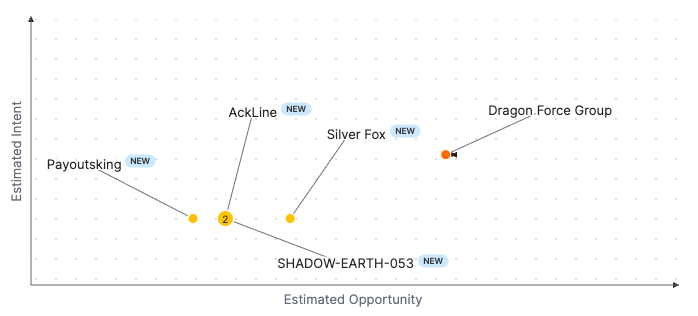
| ● Limited Severity | ● Basic Severity | ● Moderate Severity | ● High Severity |
| Threat Actor | Severity Increase | Opportunity | Intent | ||||||
|---|---|---|---|---|---|---|---|---|---|
| Dragon Force Group | ● Moderate | → | ● Moderate | ● 65 | → | ● 64 | ● 49 | → | ● 49 |
| Silver Fox | NEW | → | ● Basic | NEW | → | ● 40 | NEW | → | ● 25 |
| AckLine | NEW | → | ● Basic | NEW | → | ● 30 | NEW | → | ● 25 |
| SHADOW-EARTH-053 | NEW | → | ● Basic | NEW | → | ● 30 | NEW | → | ● 25 |
| Payoutsking |
NEW | → | ● Basic | NEW | → | ● 25 | NEW | → | ● 25 |
Global Trends Powered by Recorded Future
Within each category, we have provided the current top five globally trending items. Each item is linked to how actively trending it is and is marked with a small symbol.
The spikes in references are calculated over 60 days and are normalised to ensure they aren't disproportionate when compared to bigger entities that will naturally have more baseline mentions.
▲- Spike – This indicates a large increase in reporting volume and a high diversity in the event descriptions.
▲- Rise – This indicates a small increase in reporting volume with little diversity in the descriptions.
| Attackers | Methods | Vulnerabilities | Targets | |||||
|---|---|---|---|---|---|---|---|---|
| APT37 | ▲ | Backdoor | ▲ | CVE-2026-0300 | ▲ | IAC/InterActiveCorp | ▲ | |
| Anonymous | ▲ | WebShell | ▲ | CVE-2026-32201 | ▲ | Vimeo | ▲ | |
| Stormous Ransomware Group | ▲ | Sinobi | ▲ | CVE-2026-31431 | ▲ | DAEMON Tools | ▲ | |
| RedMike | ▲ |
ALPHV Ransomware |
▲ | CVE-2026-41940 | ▲ | Disc Soft Ltd | ▲ | |
| ShinyHunters | ▲ | Android BirdCall | ▲ | CVE-2026-29014 | ▲ | Canvas | ▲ | |
Prominent Information Security Events
Mini Shai-Hulud Campaign Conducts Cross-Ecosystem Supply Chain Compromise to Harvest Credentials and Propagate via Developer Workflows
Source: Insikt Group | Validated Intelligence Event
IOC: Hash - 907aec5b1288057a3e0885226918b6930a62a0f348ce23de026a683238c7903e
On 30th April 2026, Socket Security reported a cross-ecosystem software supply-chain attack affecting PyPI, npm, and Packagist, attributing it to the Mini Shai-Hulud campaign - a multi-stage, self-propagating malware campaign that compromises trusted packages to execute credential-stealing payloads and leverage developer infrastructure for lateral propagation. Four packages were identified as compromised: lightning@2.6.2, lightning@2.6.3, intercom-client@7.0.4, and intercom/intercom-php@5.0.2. Intercom confirmed that the root cause of its compromise was a local installation of pyannote-audio, which introduced the compromised lightning package as a transitive dependency, illustrating how a single upstream compromise can cascade across multiple ecosystems.
The campaign centres on a shared Bun-based execution model, whereby a router_runtime.js payload harvests credentials from local developer files, environment variables, and cloud sources including AWS, Azure, and GCP, before encrypting and exfiltrating stolen data to a primary command-and-control endpoint with a GitHub-based fallback. The malware also exhibits worm-like propagation behaviour, injecting postinstall hooks into local npm packages and using GitHub's GraphQL API to poison accessible repositories with malicious files. Across all three ecosystems, the campaign abuses spoofed Claude Code and Dependabot identities in commit metadata to blend into normal developer activity and evade detection.
Suspicious GitHub activity linked to the intercom-client compromise was also documented, with the account nhur tampering with disclosure issues, creating Dune-themed repositories, and pushing modified CI workflow files that accessed and staged repository secrets for exfiltration as GitHub Actions artefacts. Socket Security attributed all four package compromises to a single campaign based on shared infrastructure, near-identical payloads, and overlapping propagation artefacts. An onion link from the lightning incident pointed to a Team PCP-branded Tor-hosted website, though Socket Security was unable to independently verify claimed ties to LAPSUS$ or other threat groups.
Threat Actors Use Kuse AI Shared Markdown File to Deliver Phishing Lure and Steal Microsoft Credentials
Source: Insikt Group | Validated Intelligence Event
IOC: IP- 91[.]92[.]41[.]64
On 29th April 2026, Trend Micro reported a phishing campaign abusing the legitimate Kuse agentic AI platform to host phishing content and harvest user credentials, with at least one confirmed instance of credential submission identified. The unidentified threat actors began by compromising a vendor's email mailbox, leveraging the trusted relationship to conduct a vendor email compromise (VEC) attack against the target organisation.
Phishing emails were sent from the compromised vendor account containing links to the legitimate Kuse domain, crafted to mimic shared documents through the use of the vendor's name, spacing, and Markdown formatting. The threat actors abused Kuse's file upload and sharing functionality to host a malicious Markdown document as an intermediary stage, which presented victims with a blurred document preview to prompt interaction.
Embedded within the document was a hyperlink labelled "HAZ CLIC AQUÍ PARA VER EL DOCUMENTO" which, when clicked, redirected victims to a threat actor-controlled external domain hosting a fake Microsoft login page. The campaign is notable for its multi-stage abuse of a legitimate AI platform to bypass security controls, combining vendor trust exploitation with living-off-trusted-sites techniques to evade detection.
Remediation Actions
Following the information provided above, we recommend that the technologies mentioned be fully patched and updated. We also want to highlight and recommend applying the following patches where applicable:
-
CVE-2026-41686 (Claude SDK) – This vulnerability can be mitigated by updating to version 0.91.1.
-
CVE-2026-23918 (Apache HTTP Server) – This vulnerability can be remediated by updating to version 2.4.67 or later.
-
CVE-2026-41940 (cPanel) – These vulnerabilities can be remediated by updating cPanel, WHM and WP Squared to their respective patched versions.
If you are currently an Acumen Cyber Vulnerability Management customer, we will be proactively performing related searching and hunting activities within your environment.