


Executive Summary -
Highlights of Cyber Threat Intelligence Digest
Vulnerabilities
MongoDB Patches Critical Vulnerability CVE-2026-118383 Affecting MongoDB Server - On 10 November 2026, MongoDB disclosed CVE-2026-118383, a critical use-after-free vulnerability affecting the replication component of MongoDB Server. A threat actor can exploit the vulnerability through unauthenticated requests, potentially resulting in unexpected server termination or arbitrary code execution. At the time of writing, no active exploitation has been reported.
To reduce the risk of exploitation, organisations are advised to update MongoDB Server to versions 4.4.32, 5.0.35, 6.0.30, 7.0.48, 8.0.37, 8.3.16, or 9.0.7.
Apache Patches Actively Exploited Critical RCE Vulnerability CVE-2026-129448 in Roller XML-RPC Endpoint - On 17 November 2026, the Apache Software Foundation disclosed CVE-2026-129448, an actively exploited deserialisation-of-untrusted-data vulnerability that allows unauthenticated remote threat actors to execute arbitrary code in Apache Roller versions 4.00 through 6.1.4. The flaw stems from the XML-RPC endpoint deserialising untrusted vendor extension types before authenticating the requester.
Apache identified the flaw as the same vulnerability tracked as CVE-2026-82384, which previously listed only version 6.1.5 as affected. Apache recommends upgrading to Roller 6.1.6 or later, which disables vendor extension types and rejects XML-RPC requests when administrators disable the feature. Users who cannot upgrade should set enabledForExtensions to false in WEB-INF/web.xml or remove the /roller-services/xmlrpc servlet mapping, then restart Roller. Disabling XML-RPC through the administration interface alone does not prevent exploitation, because older versions deserialise requests before checking that setting.
Zoom Discloses CVE-2026-108186 and CVE-2026-108187 Affecting Zoom Workplace - On 10 November 2026, Zoom disclosed two vulnerabilities, CVE-2026-108186 and CVE-2026-108187, affecting Zoom Workplace for Windows. CVE-2026-108186 is a critical-severity improper input validation vulnerability affecting versions 7.1.0 through 7.1.7, while CVE-2026-108187 is a high-severity origin validation error vulnerability affecting versions prior to 7.1.5. Successful exploitation of either vulnerability allows unauthenticated threat actors with network access to escalate privileges. At the time of writing, no active exploitation has been reported.
To reduce the risk of exploitation, users are advised to install the latest security updates available at hxxps[:]//zoom[.]us/download.
Potential Threats
Threat Actor Deploys S5PIVOT Python Backconnect Proxy During Qilin Ransomware Intrusion - On 7 November 2026, Hexastrike published an analysis of S5PIVOT, a Python backconnect proxy likely derived from VIPERTUNNEL, discovered during a Qilin ransomware intrusion at a German company. The threat actor most likely gained initial access via a SonicWall SSL-VPN using valid credentials without multifactor authentication, then password-sprayed the built-in Administrator account and later reset its password on eight servers. On day five, the actor used PowerShell over WinRM under a compromised Domain Admin backup account to create a SYSTEM scheduled task launching pythonw.exe from C:\ProgramData, where sitecustomize.py loaded S5PIVOT’s payload without exposing its filename. Hidden beneath seven crypter layers, S5PIVOT acted as a SOCKS5 backconnect client over outbound TLS on port 443, authenticating via HMAC-SHA256 and opening no listening port.
The actor used AzCopy to exfiltrate filtered business data to an actor-controlled Azure blob container, with a WinRM process dump preserving the commands and showing 145 of roughly 4,300 files uploaded before a crash. Before encryption, the actor disabled Defender via DisableAntiSpyware on two servers and launched the Acronis uninstaller. The Rust Qilin encryptor, win.exe, deleted shadow copies, disabled backup and database services, and ran with flags disabling its exclusion filters, leaving several servers unbootable. It persisted via an asterisk-prefixed Run key, cleared event logs on ten servers, and likely terminated LSASS inadvertently, forcing restarts on six servers.
Threat Actor Exploits Optimizely Web Experimentation Vulnerability to Deliver Malware Targeting 178 Organizations - On 17 November 2026, Optimizely, Inc. (optimizely[.]com) reported that an unidentified threat actor exploited an unspecified vulnerability in its Web Experimentation platform to inject malicious JavaScript into customer projects. Optimizely has since patched the flaw, removed the injected code, secured affected accounts and added measures to prevent unauthorised code delivery. On 16 November 2026, Report URI (report-uri[.]com) identified malicious JavaScript in 188 of 1,611 Optimizely snippets examined, linked to 178 organisations including Zoom, BBC, Salesforce, GitLab, HSBC and IKEA, all cleaned by publication except one tied to TalkTalk. The actor modified the projectJS field in customer projects, although Report URI could not determine how write access was obtained and ruled out CDN cache poisoning. Three loader variants were identified: a script tag loading track.js from hxxps[:]//1688360[.]cc/, a Base64-encoded version of the URL, and an inline copy executed via eval if the domain was blocked.
The payload replaced cryptocurrency wallet addresses with attacker-controlled ones and harvested payment card data from forms and POST requests, exfiltrating it to 1688360[.]cc/card[.]php, while sending page URLs, accessible cookies and screenshots to 1688360[.]cc/hit[.]php. On iPhones and iPads, it could deliver Coruna to iOS 13 to 17 or DarkSword to iOS 18.x via hidden iframes. The Recorded Future Payment Fraud Intelligence team identified 1688360[.]cc on 22 e-commerce websites, although detection alone does not confirm successful theft, with further details available using the filter Attacker Domain: 1688360[.]cc. Organisations should review Optimizely code, audit write access, rotate credentials and treat card details entered on 16 November and non-HttpOnly session tokens as potentially exposed, while visitors should update iOS devices, verify cryptocurrency transactions and monitor card statements.
Threat Actors Use Quote-Request Phishing and Encrypted Scripts to Deploy SnakeKeylogger - On 12 November 2026, AhnLab’s Security Emergency Response Center (ASEC) reported that unidentified threat actors used quotation-request phishing emails to deploy SnakeKeylogger through encrypted scripts and process hollowing. The threat actors impersonated a purchasing department’s materials-management representative and asked recipients to review a quotation in an attached compressed file. The archive contained a JavaScript file which, when executed, decrypted and launched an embedded PowerShell script. That script used AES-256-CBC to decrypt a second PowerShell script and execute it in memory, which in turn used XOR to decrypt an embedded loader and executed it in memory, supplying it with the path to aspnet_compiler.exe and the final payload. The loader then started the legitimate process and used process hollowing to execute SnakeKeylogger within it.
SnakeKeylogger collects browser-stored information, system details and keystrokes, and supports exfiltrating this data via SMTP or Telegram. ASEC published an SMTP server, an authentication mailbox and a recipient address for the analysed attack. ASEC also described Telegram as an additional transmission capability but did not identify Telegram-specific infrastructure for this activity.
General News
CISA warns of ‘Java4Shell,’ an AI-found Java bug touching most of the Fortune 500 - The US Cybersecurity and Infrastructure Security Agency (CISA) issued a notice on Tuesday urging organisations to immediately patch CVE-2026-114938, a memory corruption vulnerability in Java that researchers have dubbed “Java4Shell”. According to CISA, exploitation could crash the Java Virtual Machine and enable unauthenticated remote code execution. The agency advised organisations to review software inventories for affected Java installations, including those bundled within third-party applications, and to prioritise internet-facing systems. Oracle patched the flaw in its November Patch Tuesday release, assigning it a severity score of 8.1, and credited cyber security firm Calif with its discovery. Calif, which also disclosed the widely publicised PHP vulnerabilities last month, published its own advisory noting that Java is the world’s third most popular programming language and underpins roughly 90% of Fortune 500 companies, as well as critical sectors such as banking, aviation, telecommunications and national security systems.
Calif stated that it used AI to discover the vulnerability, as it did with PHP2Shell, with one researcher identifying the flaw within an hour and developing a working exploit in two further hours at a total token cost of under $200. However, Calif noted that there is no universal exploit, as each system may require different exploitation steps. The researcher reported discovering the flaw while developing a zero-click exploit for a phone vendor, and Calif is withholding application-specific exploits and weaponised chains until organisations have had the opportunity to upgrade. Several other companies have since confirmed Calif’s findings and urged organisations to patch immediately.
Website management platform Optimizely confirms hackers put malicious code into customer sites - A breach at website management company Optimizely exposed visitors to 178 widely visited websites using its Web Experimentation platform to malicious JavaScript that stole cryptocurrency, skimmed payment cards and attempted to install malware, according to cyber security firm Report URI. Optimizely confirmed on Monday evening that it had identified and contained the incident, stating that the vulnerable path had been blocked, the injected code removed and affected customers contacted directly, and its technical advisory confirmed that a platform vulnerability allowed threat actors to inject code into customer websites. The payload was described as a multi-purpose kit that swapped cryptocurrency wallet addresses, skimmed payment cards, stole cookies and screenshots, and delivered the Coruna and DarkSword iOS exploit kits to iPhones and iPads. Blockchain evidence tracked at least $7,000 in stolen cryptocurrency, although the number of skimmed cards, stolen cookies and infected iOS devices remains unknown. Affected sites included 32 finance or banking websites alongside technology, news, airline and retail platforms, and the injected code was first observed on Turkish websites in September before the latest campaign on Monday.
Hudson Rock confirmed Report URI’s findings, while iVerify recently warned that around 75% of its spyware detections involve criminal actors deploying Coruna or DarkSword, both delivered through web-based attacks, with DarkSword requiring no user interaction beyond visiting a compromised site. InfoStealers research similarly found that poisoned third-party JavaScript has been routing iOS visitors into Coruna and DarkSword infrastructure. A Black Duck expert explained that the loader was placed in the Project JavaScript field, used to add custom code to Optimizely without a code release, and that the skimmer could only read forms built by the affected sites themselves, not payment processors’ hosted iframes. Security teams should therefore reconstruct which pages loaded the infected snippet, for how long, and which card payments those pages processed, treating every card entered on an unblocked page with a first-party card form as exposed. The incident resembles a recent attack on Fandango, where malicious code in the ticketing checkout page led to the theft of card numbers, CVVs and expiry dates.
Record number of cyber incidents reported to UK privacy regulator - British organisations reported a record 1,371 cyber incidents to the Information Commissioner’s Office (ICO) between July and September 2026, according to official figures analysed by Recorded Future News, surpassing the previous quarterly high set in 2023 and putting the UK on course to exceed its annual record. Total data security incidents, including non-cyber breaches, also reached a quarterly high of 4,604, although the figures are provisional and capture only incidents that organisations discover and report. Most were classified as “other cyber incidents”, while reported ransomware incidents continued to fall, from 1,253 in 2023 to 752 in 2024, 620 in 2025 and 321 in the first nine months of 2026. Retail and manufacturing recorded the most incidents, rising from 205 to 296 quarter on quarter, while reports from charities and voluntary organisations nearly doubled from 79 to 145, and online technology and telecommunications rose from 76 to 120. Education and childcare was the only one of the six most affected sectors to decline, from 135 to 115, and the ICO pursued formal investigations in just 18 of the 1,371 cyber incidents.
Leak-site data contrasts with the ICO’s falling ransomware figures. A director of threat intelligence at Sophos noted that, while an imperfect metric, it suggests ransomware and data-theft extortion are rising, with Sophos recording over 1,200 new victims worldwide in October, its highest monthly total and nearly two-thirds more than a year earlier, driven chiefly by Qilin, The Gentlemen and n0n alongside several newer operations. Around 350 British organisations have been named on leak sites so far this year, an increase of roughly 50% compared with a global rise closer to 25%, and several UK incident response firms reported turning away clients amid surging demand. Sophos attributed the broader threat partly to cybercriminal groups adopting AI and agent frameworks, but stressed that patching internet-facing vulnerabilities and deploying phishing-resistant multifactor authentication and passkeys would substantially reduce risk. The National Cyber Security Centre’s director for national resilience similarly highlighted that many successful attacks still exploit known, preventable weaknesses, with AI accelerating their discovery and exploitation.
Threat Actor Weekly Graph
Over the past 7 days, we have been tracking the following intent and opportunity changes within our Threat Actor Landscape.
Intent represents the potential targets of a group. When a group is observed attacking a different organisation or entity, their intent will increase.
Opportunity represents the various methods and technologies these groups may use. For example, if a group started using a new attack vector, such as a new kind of ransomware, their opportunity would increase.
Both intent and opportunity are scored out of 100 and are responsible for scoring the group's severity. These updates can be seen below.
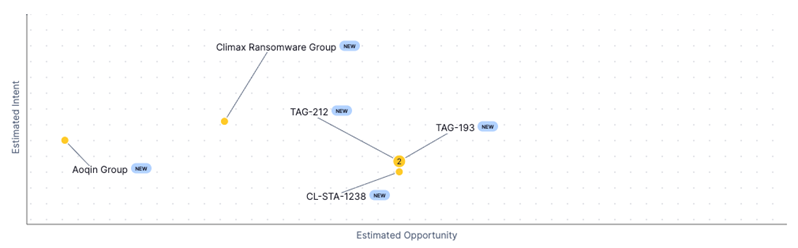
| ● Limited Severity | ● Basic Severity | ● Moderate Severity | ● High Severity |
| Threat Actor | Severity Increase | Opportunity | Intent | ||||||
|---|---|---|---|---|---|---|---|---|---|
| TAG-193 | NEW | → | ● Basic | NEW | → |
● 49 |
NEW | → | ● 30 |
| TAG-212 | NEW | → | ● Basic | NEW | → | ● 49 | NEW | → | ● 30 |
| Climax Ransomware Group | NEW | → | ● Basic | NEW | → |
● 26 |
NEW | → | ● 49 |
| CL-STA-1238 | NEW | → | ● Basic |
NEW |
→ | ● 49 | NEW | → | ● 25 |
| Aoqin Group | NEW | → | ● Basic | NEW | → | ● 5 | NEW | → | ● 40 |
Global Trends Powered by Recorded Future
Within each category, we have provided the current top five globally trending items. Each item is linked to how actively trending it is and is marked with a small symbol.
The spikes in references are calculated over 60 days and are normalised to ensure they aren't disproportionate when compared to bigger entities that will naturally have more baseline mentions.
▲- Spike – This indicates a large increase in reporting volume and a high diversity in the event descriptions.
▲- Rise – This indicates a small increase in reporting volume with little diversity in the descriptions.
| Attackers | Methods | Vulnerabilities | Targets | |||||
|---|---|---|---|---|---|---|---|---|
| PalachPro | ▲ | GravityRAT | ▲ | CVE-2026-114938 | ▲ | Equinor | ▲ | |
| Ao Qin | ▲ | EggStreme | ▲ | CVE-2026-115731 | ▲ | Asset Management | ▲ | |
| Tyler Buchanan | ▲ | Gootloader | ▲ | CVE-2026-84869 | ▲ | Mortgage Sellers | ▲ | |
| Lapsus$ Group | ▲ | DDoS | ▲ | CVE-2026-90436 | ▲ | IKEA | ▲ | |
| Silent Crow | ▲ | Coruna | ▲ | CVE-2026-99288 | ▲ | BBC | ▲ | |
Prominent Information Security Events
Threat Actor Exploits Optimizely Web Experimentation Vulnerability to Deliver Malware Targeting 178 Organizations
Source: Insikt Group | Validated Intelligence Event
IOC: IP - 34[.]87[.]36[.]58
On 17 November 2026, Optimizely, Inc. (optimizely[.]com) reported that an unidentified threat actor exploited an unspecified vulnerability in its Web Experimentation platform to inject malicious JavaScript into customer projects. Optimizely has since patched the flaw, removed the injected code, secured affected accounts and added measures to prevent unauthorised code delivery. On 16 November 2026, Report URI (report-uri[.]com) identified malicious JavaScript in 188 of 1,611 Optimizely snippets examined, linked to 178 organisations including Zoom, BBC, Salesforce, GitLab, HSBC and IKEA, all cleaned by publication except one tied to TalkTalk.
The actor modified the projectJS field in customer projects, although Report URI could not determine how write access was obtained and ruled out CDN cache poisoning. Three loader variants were identified: a script tag loading track.js from hxxps[:]//1688360[.]cc/, a Base64-encoded version of the URL, and an inline copy executed via eval if the domain was blocked. The payload replaced cryptocurrency wallet addresses with attacker-controlled ones, harvested payment card data from forms and POST requests to 1688360[.]cc/card[.]php, and sent page URLs, accessible cookies and screenshots to 1688360[.]cc/hit[.]php. On iPhones and iPads, it could deliver Coruna to iOS 13 to 17 or DarkSword to iOS 18.x via hidden iframes.
1688360[.]cc was identified on 22 e-commerce websites, although detection alone does not confirm successful theft, with further details available using the filter Attacker Domain: 1688360[.]cc. Organisations should review Optimizely code, audit write access, rotate credentials and treat card details entered on 16 November and non-HttpOnly session tokens as potentially exposed, while visitors should update iOS devices, verify cryptocurrency transactions and monitor card statements.
Threat Actor Deploys S5PIVOT Python Backconnect Proxy During Qilin Ransomware Intrusion
Source: Insikt Group | Validated Intelligence Event
IOC: Hash - 8ab791f083e47086d8286f3ac20fb3d3c5640d3b7a2a68e2cad5e497aa49f31e
On 7 November 2026, Hexastrike published an analysis of S5PIVOT, a Python backconnect proxy likely derived from VIPERTUNNEL, discovered during a Qilin ransomware intrusion at a mid-sized German company. The threat actor most likely gained initial access through a SonicWall SSL-VPN using valid domain credentials, as multifactor authentication was not enforced, although Hexastrike could not establish whether earlier leads, including an Entra sign-in campaign, infostealer logs and a commodity-stealer infection, supplied the credential. The actor then tested domain accounts, password-sprayed the built-in Administrator account to gain local administrator access, and later reset its password on eight servers to a single campaign password. Hexastrike also noted weak privilege hygiene, with more than 60 Domain Admin accounts and forest administrator credentials exposed via LSA secrets on three servers running the Acronis Managed Machine Service.
On day five, the actor used PowerShell over WinRM under a compromised Domain Admin backup account to register a randomly named SYSTEM scheduled task launching pythonw.exe every minute from a directory under C:\ProgramData. A sitecustomize.py file loaded S5PIVOT’s layered .bin payload via runpy.run_path without exposing its filename on the command line. Beneath seven crypter layers, S5PIVOT acted as a SOCKS5 backconnect client over outbound TLS on port 443, disabling certificate verification, authenticating via HMAC-SHA256 and exchanging JSON prefixed with the marker S5BC, without opening a listening port. The actor then used AzCopy to exfiltrate filtered business data to an actor-controlled Azure blob container, with a WinRM process dump preserving the commands and showing 145 of roughly 4,300 files uploaded before a crash, before deleting the tooling.
Prior to encryption, the actor set Defender’s DisableAntiSpyware value to 1 on two servers and launched the Acronis Cyber Protect uninstaller. The 32-bit Rust Qilin encryptor, win.exe, deleted shadow copies, disabled backup and database services, enabled remote symbolic-link evaluation and set the SMB MaxMpxCt value to 65535, while flags disabling its exclusion filters caused system directories to be encrypted, leaving several servers unbootable. It persisted via an asterisk-prefixed Run key, relaunching when administrators logged in days later, and cleared event logs on ten servers. Hexastrike also assessed that the encryptor’s file-release routine inadvertently terminated LSASS, forcing restarts on six servers.
Remediation Actions
Following the information provided above, we recommend that the technologies mentioned be fully patched and updated. We also want to highlight and recommend applying the following patches where applicable:
-
CVE-2026-118383 (MongoDB) - This vulnerability was fixed in versions 4.4.32, 5.0.35, 6.0.30, 7.0.48, 8.0.37, 8.3.16, 9.0.7.
- CVE-2026-129448 (Apache) - Updating Apache Roller to version 6.16 or later will remediate this vulnerability.
-
CVE-2026-108186 (Zoom) - Updating to the most recent version of Zoom/Zoom Workplace will remediate this vulnerability.
If you are currently an Acumen Cyber Vulnerability Management customer, we will be proactively performing related searching and hunting activities within your environment.