


Executive Summary -
Highlights of Cyber Threat Intelligence Digest
Vulnerabilities
CVE-2026-49480 allows Sensitive Information Disclosure affecting XWiki Plstform - CVE-2026-49480 is an incorrect authorisation vulnerability in the Solr search component of XWiki Platform that allows a remote attacker to submit crafted search queries and read confidential object content from pages they are restricted from viewing. The flaw affects XWiki Platform versions from 5.1-milestone-2 up to and including 16.10.17, 17.10.8 and 18.4.3.
Organisations are advised to update affected instances to XWiki Platform 16.10.18, 17.10.9, 18.4.4 or 18.5.0-rc-1, depending on the installed release branch.
Google Patches Critical Vulnerability CVE-2026-134401 in Chrome Variations Component - On November 23, 2026, Google patched CVE-2026-134401, a critical improper input validation vulnerability affecting Chrome versions earlier than 158.0.8127.88. Successful exploitation could allow a threat actor to execute arbitrary code outside the browser sandbox when a user loads a specially crafted HTML page. The flaw has been fixed in Chrome 158.0.8127.88/.89 for Windows and macOS, 158.0.8127.88 for Linux, 158.0.8127.92 for Android, and Extended Stable 156.0.8078.114 for Windows and macOS. Organisations are advised to update Chrome to the latest available version for their platform and ensure browsers are fully relaunched to apply the fix.
Drupal Patches Actively Exploited Critical Vulnerability CVE-2026-132165 in Core Installer - On November 18, 2026, Drupal patched an actively exploited remote code execution (RCE) vulnerability tracked as CVE-2026-132165, affecting Drupal core versions earlier than 10.6.22, versions 11.0.0 through 11.3.21, and versions 11.4.0 through 11.4.12. Exploitation allows unauthenticated threat actors to take over vulnerable websites or execute arbitrary code under specific configurations. At the time of writing, the identity of the threat actor behind this exploitation remains unknown.
To prevent threat actors from exploiting this vulnerability, It is recommended to update Drupal core to versions 10.6.22, 11.3.22, or 11.4.13, depending on the installed release branch.
Potential Threats
OXLoader Campaigns Use DLL Hijacking to Deliver Multiple Malware Families - On November 23, 2026, increased activity was reported involving OXLoader, a previously undocumented Windows loader first observed in a campaign delivering CASTLESTEALER. Threat actors distribute OXLoader through phishing emails alleging copyright or intellectual property violations, ZIP archives hosted on Google Sites containing renamed WinWord.exe files with double extensions such as evidence_of_violation.docx.exe, and GitLab pages offering fake activators and cracks for software including CapCut Pro, FL Studio and Office. The loader relies heavily on DLL sideloading via legitimate executables associated with Microsoft applications, Steam, OBS Studio and Take-Two Interactive, using malicious DLLs such as UnityPlayer.dll, msvcr100.dll and Qt5Widgets.dll to decrypt and execute OXLoader, which is obfuscated using control-flow flattening and mixed Boolean arithmetic. OXLoader has been observed delivering payloads including Remcos, PureRAT, Lunex Stealer, OverLord, LOLD and Hermes, enabling credential theft, remote access and the deployment of additional malware.
Threat Actors Exploit GL.iNet GoodCloud Vulnerability to Deploy Malware and Reverse Shells - On November 22, 2026, BleepingComputer reported an exploitation targeting a vulnerability in GL.iNet's GoodCloud remote management platform to deploy malware, persistent backdoors, and reverse shells on routers and keyboard, video, and mouse (KVM) devices. GoodCloud is a cloud-based service that enables users to remotely manage GL.iNet networking equipment and KVM devices.
On November 20, 2026, GL.iNet confirmed that an unauthorised party exploited its cloud infrastructure to access customer devices and install malicious software. Researchers from RemoteToHome Consulting identified a command injection vulnerability in the GoodCloud client that allows cloud-supplied commands to execute with root privileges without proper input validation.
New Go-Based MacOS Infostealer with RAT Capabilities Targets Keychains, Wallets and Browsers - On November 20, 2026, a new Go-based macOS infostealer named Pear.Stealer was reported, combining credential theft with remote access capabilities. The malware relies on social engineering rather than exploitation, displaying a fake AppleScript System Settings dialog claiming a pending system update to capture and validate the victim's password, before using it to unlock and dump the login Keychain. Pear.Stealer targets Chromium, Firefox and Safari credentials and cookies, cryptocurrency wallets and recovery phrases, SSH keys and cloud credentials, and includes a clipper that replaces copied cryptocurrency addresses with attacker-controlled ones.
Where Accessibility and Screen Recording permissions are granted, it also provides VNC-style remote control, a reverse shell and a SOCKS tunnel. Persistence is achieved through a LaunchAgent at ~/Library/LaunchAgents/com.apple.security.helper.plist, with command and control infrastructure hosted on ray-id-v3[.]com and re-id-v3[.]com, which organisations are advised to block.
General News
Crowdstrike to Purchase Zscaler - On November 23, 2026, CrowdStrike announced it will acquire cloud security company Zscaler for $43.9 billion in an all-stock deal, consolidating two of the largest companies in the cybersecurity industry. Under the terms, Zscaler shareholders will receive 1.135 shares of CrowdStrike common stock per Zscaler share, valuing each at $260.41, with existing CrowdStrike shareholders expected to own 84.1% of the combined company. The acquisition combines CrowdStrike's endpoint security, incident response and threat intelligence offerings with Zscaler's zero trust and network security products, marking CrowdStrike's entry into the network security market and giving it access to around 8,000 Zscaler customers not currently using its platform. Zscaler's CEO will continue to lead the company and join CrowdStrike's board, with both firms positioning the deal around securing enterprise AI adoption and agentic applications. The deal surpasses Google's $32 billion acquisition of Wiz as the largest in the sector to date.
ShinyHunters Claim to Return After FBI Arrests - BleepingComputer reported that the ShinyHunters extortion gang claims to have returned in posts on a new data leak site after a series of arrests over the past two months targeting alleged members, with the group using old PGP keys in an attempt to verify that the posts are genuine. The resurgence follows sustained law enforcement action against the group, including the FBI's arrest of another suspected member believed to be involved in the recent breach of FBI systems, which ShinyHunters claimed it achieved by exploiting an alleged Oracle PeopleSoft zero-day vulnerability before moving laterally into FBI-managed AWS GovCloud infrastructure. Due to the decentralised nature of the operation, remaining members may change the group's name or spin off to other hacking gangs, and cybercriminals have continued to conduct data theft and extortion attacks against organisations worldwide under the ShinyHunters name despite the arrests.
US Based Education Company Turnitin Discloses Cyber Attack - On November 23, 2026, US-based educational technology company Turnitin disclosed unauthorised activity involving certain customer-facing systems. The company said it was investigating the incident's nature and scope. Turnitin had not confirmed whether customer information was accessed or stolen, the type of data, when the activity occurred, or whether a responsible threat actor was identified.
Turnitin's systems were fully operational and safe to use. The company also said the affected customer-facing systems do not collect government identification credentials or institutional financial information.
Threat Actor Weekly Graph
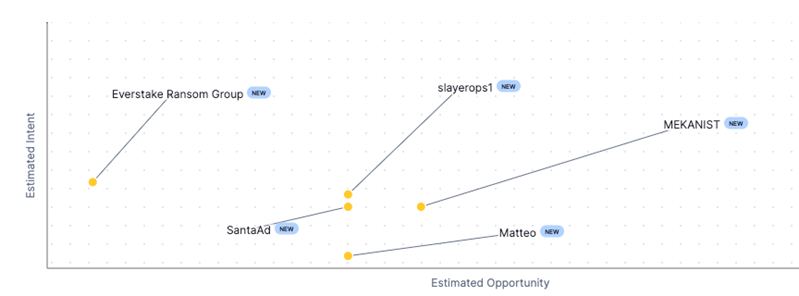
Over the past 7 days, we have been tracking the following intent and opportunity changes within our Threat Actor Landscape.
Intent represents the potential targets of a group. When a group is observed attacking a different organisation or entity, their intent will increase.
Opportunity represents the various methods and technologies these groups may use. For example, if a group started using a new attack vector, such as a new kind of ransomware, their opportunity would increase.
Both intent and opportunity are scored out of 100 and are responsible for scoring the group's severity. These updates can be seen below.
| ● Limited Severity | ● Basic Severity | ● Moderate Severity | ● High Severity |
| Threat Actor | Severity Increase | Opportunity | Intent | ||||||
|---|---|---|---|---|---|---|---|---|---|
| MEKANIST | NEW | → | ● Basic | NEW | → |
● 41 |
NEW | → | ● 25 |
| slayerops1 | NEW | → | ● Basic | NEW | → | ● 33 | NEW | → | ● 30 |
| SantaAd | NEW | → | ● Basic | NEW | → |
● 33 |
NEW | → | ● 25 |
| Everstake | NEW | → | ● Basic |
NEW |
→ | ● 5 | NEW | → | ● 35 |
| Matteo | NEW | → | ● Basic | NEW | → | ● 33 | NEW | → |
● 5 |
Global Trends Powered by Recorded Future
Within each category, we have provided the current top five globally trending items. Each item is linked to how actively trending it is and is marked with a small symbol.
The spikes in references are calculated over 60 days and are normalised to ensure they aren't disproportionate when compared to bigger entities that will naturally have more baseline mentions.
▲- Spike – This indicates a large increase in reporting volume and a high diversity in the event descriptions.
▲- Rise – This indicates a small increase in reporting volume with little diversity in the descriptions.
| Attackers | Methods | Vulnerabilities | Targets | |||||
|---|---|---|---|---|---|---|---|---|
| CyberPartisans | ▲ | SilentNet | ▲ | CVE-2026-132165 | ▲ | ODNI | ▲ | |
| FinCen | ▲ | Artex AI | ▲ | CVE-2026-114938 | ▲ | US Government | ▲ | |
| Lapsu$ | ▲ | Chisel | ▲ | CVE-2026-76466 | ▲ | Open Source | ▲ | |
| slayerops1 | ▲ | MedusaLocker | ▲ | CVE-2026-128090 | ▲ | EU Comission | ▲ | |
| Lazarus | ▲ | Cyberstrike | ▲ | CVE-2026-134624 | ▲ | Checkpoint | ▲ | |
Prominent Information Security Events
OXLoader Campaigns use DLL Hijacking to Deliver Multiple Malware Families
Source: Insikt Group | Validated Intelligence Event
IOC: Domain - guestsisfilesjpmp[.]com
IOC: IP - 91[.]92[.]243[.]204
On 23 November 2026, increased activity was reported involving OXLoader, a previously undocumented Windows loader first observed in a campaign delivering CASTLESTEALER, which is now being used across multiple campaigns to deliver Remcos, OverLord, PureRAT, Lunex Stealer, LOLD and Hermes. Threat actors distribute the loader through phishing emails alleging copyright or intellectual property violations with PDF attachments linking to ZIP archives, Evidence_of_Violation.zip archives hosted on Google Sites containing renamed WinWord.exe files with double extensions such as evidence_of_violation.docx.exe, batch files downloading archives from hosting sites, and GitLab pages offering fake activators and cracks for CapCut Pro, FL Studio and Office.
In the GitLab activator campaign, the victim launches a legitimate Take-Two Interactive executable that sideloads a trojanised UnityPlayer.dll, which decrypts OXLoader and later injects encrypted shellcode from manifest.json into the .text section of a legitimate DLL such as windows.storage.dll. Other sideloaded DLLs include Qt5Widgets.dll, Qt6Core.dll, SDL3.dll, ANCUtility.dll, dbghelp.dll and msvcr100.dll. OXLoader uses control-flow flattening and mixed Boolean arithmetic for obfuscation, checks for virtualised environments, fewer than three CPUs, display refresh rates below 20 Hz, Russian UI language and CIS geolocations, and shuts down the host if an analysis environment is detected. It copies its files to a randomly named seven-character folder in ProgramData and establishes persistence via a HKCU RunOnce registry value, before Donut Loader executes a LOLD downloader using ghosted hollowing injection techniques. Related Hermes activity was observed making HTTP requests over ports 8093, 8080 and 8700 to paths including /chunks/, /ws/publisher, /files and /api/modules/.
LOLD C2 servers were identified at 217[.]60[.]102[.]123 and 91[.]92[.]243[.]204, with distribution domains including guestsisfilesjpmp[.]com, wovplaying[.]help, biklonasmain[.]net, videohostinginsort[.]net and videovisitors[.]com, all currently inactive. Organisations should block executable attachments and archives with double extensions, restrict execution from user-writable and ProgramData directories, prevent the download of cracked software, and monitor for trusted applications loading unexpected DLLs, suspicious RunOnce entries and outbound connections to the reported ports and paths.
Threat Actors Exploit GL.iNet GoodCloud Vulnerability to Deploy Persistent Malware and Reverse Shells
Source: Insikt Group | Validated Intelligence Event
IOC: IP - 66[.]245[.]219[.]252
IOC: IP - 170[.]39[.]226[.]219
On 20 November 2026, GL.iNet confirmed that an unauthorised party exploited its GoodCloud remote management platform to access customer routers and keyboard, video and mouse (KVM) devices and deploy malware, persistent backdoors and reverse shells. GL.iNet later attributed the activity to a GoodCloud message-authorisation configuration error and a separate command injection flaw in the AstroWarp SD-WAN functionality, which allows cloud-supplied commands to execute with root privileges without input validation. The vulnerable handler has been present in firmware since December 2024 and can execute commands even when AstroWarp is disabled. Evidence of malicious activity was identified on 152 of 183 routers examined, including 24 with root-level reverse shells, 47 with an older persistent backdoor and 81 showing threat actor-supplied command execution.
After gaining access, threat actors established root-level reverse shells using nc to 170[.]39[.]226[.]219, with other devices reporting searches for gl-helper implant directories to the same address. On 19 November 2026, a compromised GL-RM1 KVM downloaded a malicious shell script named ni.sh from 66[.]245[.]219[.]252, which fingerprinted the device model, retrieved the gl-helper and gb payloads, and established persistence through startup scripts, scheduled tasks and SSH public keys. The script disguised a malicious process as crond -i /tmp/.log, timestomped files, replaced netstat with a script filtering connections to its C2, and monitored /etc/rtty_conf to maintain an rtty connection to 65[.]20[.]71[.]131. An older backdoor modified /etc/init.d/urandom_seed to launch a Lua payload disguised as monitord and altered /lib/upgrade/keep.d/netifd to survive firmware upgrades. Some infected devices also contacted around 1,800 residential IP addresses daily and queried the TRON blockchain API for an undetermined purpose.
GL.iNet has blocked the cloud access path and released security firmware updates, although the fix does not remove existing malware. Organisations should update all GL.iNet routers and KVM devices to the latest firmware, temporarily disconnect GoodCloud access, block 170[.]39[.]226[.]219, 66[.]245[.]219[.]252 and 65[.]20[.]71[.]131, and hunt for ni.sh, gl-helper, gb and modified startup scripts using upstream network telemetry rather than local command output. Confirmed compromised devices should be isolated and reflashed, with any computers connected to infected KVM devices investigated and exposed credentials rotated from clean systems.
Remediation Actions
Following the information provided above, we recommend that the technologies mentioned be fully patched and updated. We also want to highlight and recommend applying the following patches where applicable:
-
CVE-2026-49480 (XWiki) - Updating XWiki Platform to version 16.10.18, 17.10.9, 18.4.4 or 18.5.0-rc-1, depending on the installed release branch, will remediate this vulnerability.
- CVE-2026-134401 (Chrome) - This vulnerability was fixed in versions 158.0.8127.88/.89 for Windows and macOS, 158.0.8127.88 for Linux, 158.0.8127.92 for Android and Extended Stable 156.0.8078.114 for Windows and macOS.
-
CVE-2026-132165 (Drupal) - Updating Drupal core to version 10.6.22, 11.3.22 or 11.4.13, depending on the installed release branch, will remediate this vulnerability.
If you are currently an Acumen Cyber Vulnerability Management customer, we will be proactively performing related searching and hunting activities within your environment.